.png)
Complexity Is the Enemy of Care: Aaron Michael Krinsky on What His Daughter’s Diabetes Taught Him About Broken Systems
A father's five-year immersion inside his daughter's medical care reveals why systems keep solutions people never see.
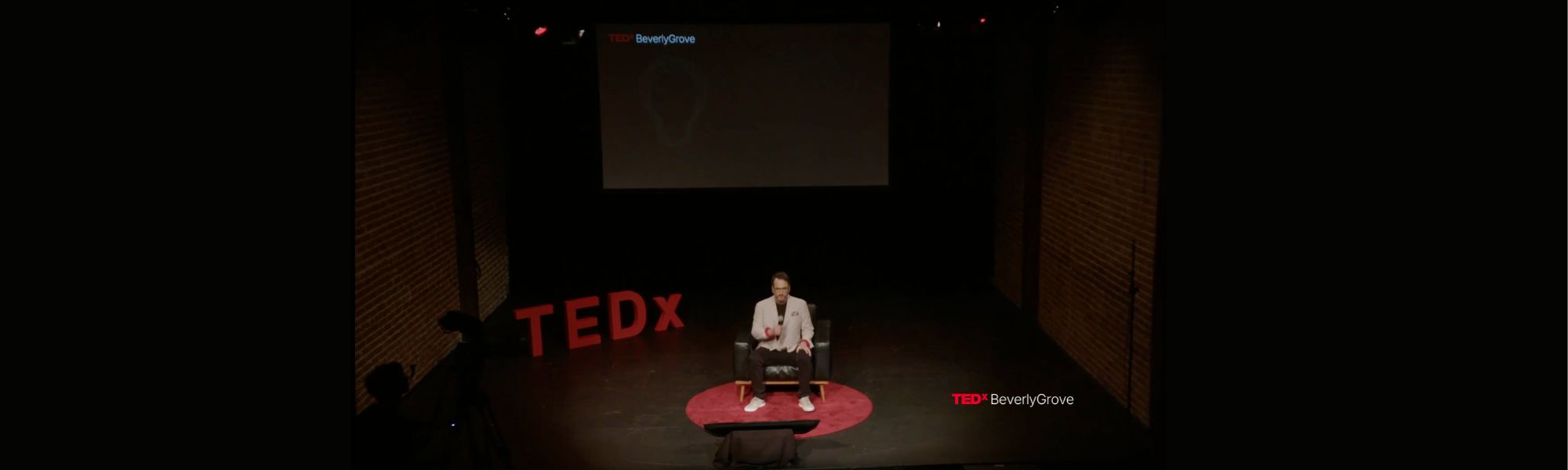
Three days before his daughter Rumijean’s first birthday, Aaron Michael Krinsky and his wife Emily rushed her to the emergency room.
What they thought was a stomach bug was type 1 diabetes. Rumi was in diabetic ketoacidosis, and she had to be airlifted to the nearest children’s hospital.
At TEDxBeverlyGrove 2026, under the theme “Reimagining the Possible,” Krinsky told the TEDxBeverlyGrove audience what came after his daughter survived that flight, and what five years of managing her illness taught him about the systems people are told to simply accept.
Krinsky described learning to live inside a medical device ecosystem built around separate devices, separate sites, separate alarms, and separate responsibilities. Families managing type 1 diabetes often rely on a continuous glucose monitor, an insulin pump, and software that helps translate glucose readings into insulin delivery decisions. For Krinsky, the burden was not only the disease itself. It was the complexity surrounding the disease.
He pointed to research and innovation exploring whether glucose sensing and insulin delivery could be brought closer together, including combined-device and single-site approaches designed to reduce the burden of managing multiple systems. His larger argument was not simply about one device. It was about what happens when complexity becomes normalized long after people stop asking whether the system is still serving the patient.
“Complexity doesn’t just create friction,” Krinsky told the audience. “It creates distance from responsibility, from empathy, and from care itself.”
The turning point in Krinsky’s talk came over coffee with a childhood friend who also lives with type 1 diabetes. His friend showed him an automated, open-source approach to managing the disease that most patients have never been offered through standard care, one that had dramatically improved his friend’s daily numbers. Krinsky described the moment as both a relief and a reckoning, realizing that much of what his family had accepted as unavoidable deserved to be questioned.
Krinsky’s talk argued that this same pattern shows up far beyond healthcare. Systems add complexity to solve a problem, then preserve that complexity long after it stops serving the people inside them. He pointed to education, finance, and technology as places where the same question applies: when does a system stop solving the problem and start protecting itself?
Krinsky closed by calling for “one device by 2030,” his stated clarion call for a standard of care that reduces the number of devices, decisions, alarms, and layers of friction standing between families and the care they need. The goal, he argued, is not innovation for its own sake. It is care designed around the patient, not around the machinery of the system.
The talk ended with an ordinary morning with his daughter, a moment that made clear what simplification would actually mean. Not a theory. Not a product category. A child’s life made less complicated by adults willing to ask whether the system they inherited is still good enough.
Aaron Michael Krinsky has spent his career at the intersection of technology, design, and innovation. He began his career at IMAX in its digital division and has since co-founded and invested in companies across media, technology, and healthcare. He lives in Central Oregon with his wife, Emily, and their three children.
Aaron Michael Krinsky’s talk will be released online in the coming months as part of the TEDxBeverlyGrove 2026 speaker series.

Aaron Michael Krinsky has spent his career at the intersection of technology, design, and innovation. He began his career at IMAX in its digital division and has since co-founded and invested in companies across media, technology, and healthcare. Raised in Laguna Beach, California, Krinsky studied at Yale University and earned his master’s degree from the University of Southern California. He lives in Central Oregon with his wife, Emily, and their three children. At TEDxBeverlyGrove Aaron Michael Krinsky will share “Complexity Is the Enemy of Care: What My Daughter’s Illness Taught Me About Broken Systems.” It’s a field report from inside a system that means well—and still fails people. The takeaway isn’t a perfect solution; it’s the discipline of removing friction so responsibility stays close, empathy stays intact, and care becomes doable again.
TEDxBeverlyGrove 2026 — “Reimagining the Possible” was held Saturday, March 14, 2026, at the Marilyn Monroe Theatre, West Hollywood, California. The event brought together twelve speakers, sponsors, brand partners, and volunteers for a full day devoted to ideas worth spreading. Speaker talks will be released online in the coming months.
Marvin V. Acuna is a TEDx Organizer and Producer. In that role, he curates speakers, ideas, and the architecture of a high-trust live stage.
Separate from his work as a TEDx producer, Acuna advises leaders, founders, attorneys, and public figures as a speaking coach and talk architect. He helps clients uncover the idea inside their story, sharpen their message, and deliver it with clarity, authority, and impact. He also serves as Head of Business Strategy for The Lawyers Roundtable and is the founder of MoBal Systems.
TED is a nonprofit, nonpartisan organization dedicated to discovering, debating and spreading ideas that spark conversation, deepen understanding and drive meaningful change. Our organization is devoted to curiosity, reason, wonder and the pursuit of knowledge — without an agenda. We welcome people from every discipline and culture who seek a deeper understanding of the world and connection with others, and we invite everyone to engage with ideas and activate them in your community.
TED began in 1984 as a conference where Technology, Entertainment and Design converged, but today it spans a multitude of worldwide communities and initiatives exploring everything from science and business to education, arts and global issues. In addition to the TED Talks curated from our annual conferences and published on TED.com, we produce original podcasts, short video series, animated educational lessons (TED-Ed) and TV programs that are translated into more than 100 languages. Through The Audacious Project, TED has helped catalyze $6.6 billion in funding for projects that support bold solutions to the world’s most urgent challenges. Follow TED on Facebook, Instagram, LinkedIn, TikTok, and X.
In the spirit of ideas worth spreading, TEDx is a program of local, self organized events that bring people together to share a TED-like experience. At a TEDx event, TED Talks video and live speakers combine to spark deep discussion and connection. These local, self-organized events are branded TEDx, where x = independently organized TED event. The TED Conference provides general guidance for the TEDx program, but individual TEDx events are self-organized. (Subject to certain rules and regulations.)
This independent TEDx event is operated under license from TED.
.png)
.png)